
The Mansion
Not big box. Not residential. The deliberate middle.
When a family starts looking for assisted living, they usually find two kinds of places. Each one gets something right. Neither gets everything.
The big-box facility
This is the building most people picture: a large institutional setting with long hallways and a hundred or more residents under one roof. It often has plenty of amenities. What it struggles to offer is attention. Staff rotate, and the person helping today may not know the resident in front of them. Meals tend to arrive the way they do in an institution, on a tray.
Amenities, without the attention.
The converted residence
At the other end is residential assisted living: a family residence in a neighborhood, adapted for care. It is small, so residents are known. But the building was never designed for this work. Common space is limited, amenities are few and care services are usually basic.
Attention, without the amenities.
The boutique Mansion
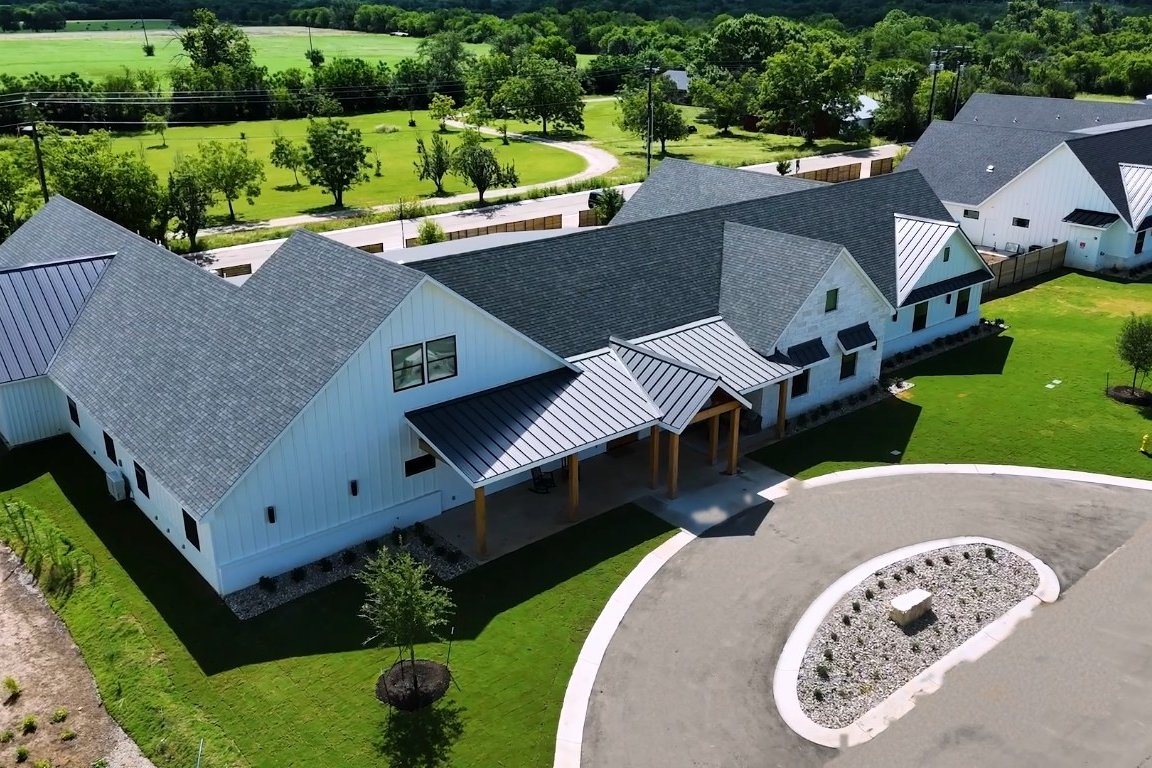
We sit deliberately between the two. A Mansion is purpose-built for assisted living and memory care, on a single story, with sixteen private suites per building. Each suite has its own bath, fireplace and TV. Daily life centers on a great room and an open kitchen, where a chef prepares meals that residents can see and smell.
And because there are only sixteen residents, one dedicated team knows every one of them by name.
Both, by design.
Why the middle is hard to copy
The middle only works when the building and the operation are designed together. That is why we work with a strategic partner whose Mansions are already built, open and operating, and why we build to their standard design instead of inventing our own.
Descriptions of other types of communities are general and do not refer to any specific community or operator.
Follow the build.
A short note when something real happens. No pitch.